RSS

Category Archives: Pop Life

Hurricane Updates…

Penny: Welcome back to our non-stop, repetitive coverage of Hurricane Irene, the Category 1 storm that has killed more than a dozen people, cost billions in damage, and limited the pizza delivery options of New Yorkers.

Dan: Right, Penny, this is a dangerous storm, which is why we’re here rather than the normal loser weekend anchors.

Penny: Of course, Dan, my presence here has nothing to do with JFK cancelling my flight to Bermuda. Now, instead of actual reporting, we’re going to read you some updates from random people on Twitter and Facebook.

Dan: Susie from Staten Island reports that the little mermaid Ariel has beached herself on Far Rockaway. She probably missed an exit while coming up the Atlantic, which is why we warn you to stay inside where it’s safe.

Penny: Definitely, there’s no sense putting your life at risk. Now, let’s go to our high school intern Chip reporting from a life raft tied to a minke whale on its way to the Cape.

Chip: Oh, my God, I’m so scared. I don’t think this whale is a strong swimmer. It’s sort of dog paddling.

Penny: That’s great, Chip. So, what are you seeing out there?

Chip: It’s pretty much just like the footage you’re showing except I’m out here and in great peril. I am still getting college credit at Columbia, right?

Penny: Exactly, credit at a college in Colombia. Now, let’s go to Dan with more updates from Facebook.

Dan: Thanks, Penny, Marty from Montauk says that trees are down on Route 28 but that Bigfoot is helping clear them away and directing traffic from the more treacherous areas.

Penny: What a swell guy. So, again we want to stress that it’s dangerous out there, please stay home and ride this out. That’s the sane and responsible thing to do. Now, let’s go to Lois reporting live from the Statue of Liberty.

Lois: Hello, Penny, as you can see I’m out on the torch here. It’s closed to the public but I broke in to demonstrate how stupid it would be if you were to come out here during this storm. In fact, I’m going to stand on the ledge in my six-inch heels and wave my arms to reinforce my point.

Penny: Good luck with that, Lois. Dan, any more Facebook updates?

Dan: Yes, Irrationally Worried Grandmother in Ohio is convinced that the hurricane has killed her grandson who lives in Sacramento.

Penny: Well, if he doesn’t call her within the hour, I think that’s the only possible conclusion. Has Irene spread to the West Coast? We’ll have more on that later in the hour but first let’s see if Lois is dead yet.

Lois: I’m still very much alive, Penny.

Penny: Oh, shucks. Well, maybe Chip.

Dan: Yeah, he’s a goner. That whale can’t swim worth a damn. Lois, I see you’re still standing on the torch.

Lois: Yes, Dan, and for my next trick, I’m going to do the Charleston while holding my head back with my mouth open while trying not to drown.

Penny: Amazing, look at her go! And to think she has no training in dance.

Lois: No, actually, I’ve taken dance classes. I just never went to journalism school.

Dan: Well, that makes sense.

 
Leave a comment

Posted by on August 28, 2011 in Pop Life


Tags: , ,

Recurring Feature (at least until I tire of it): “Terrible Things”…

If I had my way, all TV commercials would consist of white text over a black screen that details the objective value of the product advertised… perhaps with a Morgan Freeman or Gene Hackman voiceover. I want to be informed not entertained.

Neither informative nor entertaining is the current HP ad featuring actress Lea Michele:

The promoted product is the HP TouchPad — the Gobot to the Apple iPad’s Transformer (really, “Leader-1” and “Cop-Tur”? That’s the best you can do against “Optimus Prime” and “Megatron”?). CNET provides a more relevant review.

My issue is less with the TouchPad but with the use of one of my favorite songs,Jule Styne and Stephen Sondheim’s “Let Me Entertain You” from “Gypsy.” Rather than commissioning a unique jingle (e.g. “I’d Like to Teach the World to Sing in Perfect Harmony” —  commercialism disguised as a message of hope but at least creative), it repurposes an existing song whose lyrics superficially match the advertised message (another example is Honey Bunches of Oats’ use of The Andrea True Connection’s “More, More, More”).

“Let Me Entertain You” is simultaneously sexy and innocent — as it’s performed in the show as both a children’s vaudeville act and later a burlesque number. The lyrics “I’m very versatile” and “I want your spirit to climb” manage to suit both purposes (Sondheim’s genius at work). It’s also a key song for Louise Hovick, who over the course of three minutes steps out of her sister June’s shadow and emerges as Gypsy Rose Lee.

Michele’s performance conveys none of this. It’s just a flat knock-off for… well, I guess, a flat knock-off.

Sandra Church’s version from 1959 can’t be touched but I leave you with my second-favorite performance of the song from 1987:

 
1 Comment

Posted by on August 18, 2011 in Pop Life


Fun with Bert and Ernie…

Fun with Bert and Ernie…

There was a fairly silly online petition going around proposing that “Sesame Street” marry off Bert and Ernie. I found it silly because Bert and Ernie are not necessarily adult characters but a child’s fantasy of what it would be like to live with your best friend. However, the reaction to this mostly benign petition is even sillier.

“Sesame Street” released a statement on Thursday regarding the petition that struck me as defensive and misguided.

Bert and Ernie are best friends. They were created to teach preschoolers that people can be good friends with those who are very different from themselves. Even though they are identified as male characters and possess many human traits and characteristics (as most Sesame Street Muppets™ do), they remain puppets, and do not have a sexual orientation.

Peter Roff of U.S. News and World Report further reinforced the Sesame Workshop’s assertion that “puppets” do not have “sexual orientation.”

(Bert and Ernie) are funny, engaging characters who demonstrate to children that people—no matter how different they might be in temperament, likes, dislikes and personalities—can still be the best of friends. But they are also, as apparently has been lost on some people, Muppets—a combination marionette and foam rubber puppet invented decades ago—by the legendary Jim Henson and his wife Jane. Muppets are not people, and while they are in many cases gender specific they, as the Sesame Workshop felt compelled to point out Thursday, “Do not have a sexual orientation.” Nonetheless someone out there thinks they would be useful to further a point about sexual identity.

However, as writer MaryAnn Johanson points out, this retroactive neutering of the Muppets is demonstrably false.

But… Kermit the Frog and Miss Piggy are puppets, too, and yet they clearly have sexual orientations (not to mention the other more problematic issue of transspeciesism). And Kermit was originally a Sesame Street Muppet. And Elmo has parents, Mae and Louis. So clearly Sesame Street Muppets can have sexual orientation… as long as its hetero.

Johnson is correct and shines a light on one of the more insidious undercurrents regarding how many heterosexuals view homosexuals: They are defined by their sexual identity and that sexual identity is unsettling. Thus, Kermit and Miss Piggy’s relationship, a core component of most of the films and TV shows involving them, is both normal and appropriate for children. Bert and Ernie as a couple would, as Roff fears, “further the end of childhood innocence in America.”

There’s no logical reason why a child could comprehend a heterosexual couple more easily than a homosexual one. True, there is the relatability of a male and female couple but how much of that is a ramification of most children growing up in such an environment compared to its being a dominant image in books, TV, and film? Also, when children see a couple, their minds don’t generally move directly to what the couple does in the bedroom. Without their parents’ hangups influencing them, they would probably see a homosexual couple through the same lens as a heterosexual couple: Two people who live together and are a family.

Upon reflection, I think the petition’s goal was to show children that a gay couple is not just normal but is as capable of innocence as a heterosexual couple (I also found Miss Piggy’s romantic aggressiveness rather forward-thinking at the time). This is what Roff and others like him wish to deny gays, so they make the specious argument that if “Sesame Street” decided to make Bert and Ernie a couple, the show is suddenly no longer for kids. It’s essentially “Queer as Folk” in felt. Gays are nothing more than their sexuality, the deviant behavior the Bachmanns of the world wish to “cure.” Love, commitment, and family are all the province of heterosexuals.

The petition also makes the valid point that the “indoctrination” Roff fears is not a negative. If we believe that children are not simply sociopaths — I’m not entirely convinced — then we must understand that they are naturally inclined to mock what they don’t understand or what’s different. “Sesame Street” has for years played a part in minimizing those areas of ignorance. If Roff thinks that children are not “sophisticated” enough to be exposed to a gay couple, then what did he think of Christopher Reeve’s appearance on the show, during which Reeve explained his paralysis to Big Bird?

I have no issue with “Sesame Street” choosing to keep Bert and Ernie as heterosexuals. Frankly, the obvious jokes about their relationship was as tiresome and off-the-mark as the ones about Batman and Robin. It’s just unfortunate that the Sesame Workshop would have to fall into the even more tiresome and off-the-mark perspectives of homosexuality.

 
1 Comment

Posted by on August 12, 2011 in Pop Life


Tags: , , ,

Forever Marilyn…

Almost 50 years since her death, Marilyn Monroe still cannot escape exploitation or bad likenesses of her presented as art (a motley crew that includes Catherine Hicks — yes, the mom from “7th Heaven” — and Mira Sorvino — yes, Mira Sorvino).

New Jersey sculptor J. Seward Johnson Jr.’s Forever Marilyn is currently on display on Michigan Avenue in Chicago. It is large, obvious, and tacky — everything Marilyn was not — and has so far proven to be the biggest magnet of mediocrity since the creation of the reality TV genre.

An article in the Chicago Tribune describes a throng of “tourists hugging her legs and voyeurs young and old unabashedly shooting upskirt photos on their iPhones.” While this would be rude if the 26-foot statue were a living, breathing entity, it is distinctly irrational and borderline insane behavior when you consider that the statue is an inanimate object.

The statue is based on a famous scene from Marilyn’s 1955 film, The Seven Year Itch. After the range she displayed as the femme fatale in Niagara (1953) and the comedic chops demonstrated in Gentlemen Prefer Blondes and How to Marry a Millionaire (both also 1953), her role is a bit of a come-down. She is the unnamed “girl” who symbolizes the tempation Tom Ewell’s character experiences during a sweltering New York City summer. However, unlike the previously mentioned films, its success is solely attributable to her, as she embues it with the classic Marilyn Monroe persona.

When I saw the scene within the full context of the film, I was moved by Marilyn’s sensitivity. Could anyone else see “Creature from the Black Lagoon” and identify with the monster? “He was kind of scary looking,” she concedes, “but he wasn’t really all bad. I think he just craved a little affection.” This consideration for the outcasts in all of us is what separates Marilyn from all the knock-offs who dress up as her at costume parties. Unfortunately, they probably have only seen the clips of the scene that begin with her hopping on the subway grate and making history. Viewed without this glimpse into her heart, she’s just a tart, desperate for attention from a man. A spontaneous display of innocence is now interpreted as calculated seduction.

http://www.youtube.com/watch?v=zGlu06VDCdU

My issue is not with the sculpture itself but with the public’s reaction to it — the lack of respect and the desire to consume. It is an unfortunate reflection of what happened to Marilyn in life. I’m not sure if that was Johnson’s intent but his official statement does encourage people to “…come close and actually touch” the statue.

“There is something about her pose; the exuberance for life without inhibition, which is quintessentially American. It expresses an uninhibited sense of our own vibrancy.”

However, “life without inhibition” could describe Madonna at best or the cast of “Jersey Shore” at worst. Neither is truly Marilyn, but I suppose I should thank Johnson for the resulting performance art the statue has generated and its comment on our society. For example:

Expect to see these guys involved in whatever version of a “sexting” scandal will exist thirty years from now.

Uncertain as to what he’s celebrating. He was photographed between the legs of a statue. Is that the silver or bronze?

I presume this woman is attempting to recreate Marilyn’s famous pose — but without the skirt and with the regrettable side effect of looking like she’s about to relieve herself in the statue’s presence.

Forever Marilyn is scheduled to remain in Chicago’s Pioneer Court until the spring.

 
Leave a comment

Posted by on July 23, 2011 in Pop Life


Tags:

Sartre and “South Park”…

I saw “The Book of Mormon” and it left me cold. My response to anyone who asks my opinion about the show would be a diplomatic and mostly accurate, “If you enjoy ‘South Park,’ you’ll probably enjoy this” or as Lincoln put it best: “People who like this sort of thing will find this the sort of thing they like.”

There are some who are curious as to why I specifically didn’t enjoy the show. I do support anything that brings people to the theatre that is not based on a movie, a video game, or an injury-prone superhero. I am also pleased to see job opportunities for black stage actors even if it does involve them raising the ghost of Hattie McDaniel in a misguided (and somewhat inaccurate) send-up of Africa: I don’t mind satire but I do mind laziness, and “The Book of Mormon” has all the racial sophistication of a Tarzan movie.

I underscore laziness here because it’s a rather tiresome trope: Blacks in an awful situation who are powerless to do anything to change their circumstances without the aid of a white savior — one they eventually wind up almost worshipping in “Book of Mormon.” It’s been depicted so often, though, that it’s almost a genre in itself, going back to “To Kill a Mockingbird” and later “Dangerous Minds” (though “Amish Paradise” is a great song).

However, that didn’t bother me as much as the prodution’s overall message, which is a promotion of inauthentic living. The Africans start out cursing a non-existent God because their lives are miserable but they make no attempt to alter them through their own force of will. They are essentially frustrated children who blame their parents for why they weren’t born handsome and tall. Their emotional arc, such as it is, has them embracing and uniting over nonsense. Worse, they know it’s nonsense, which is what Sartre would condemn as the worst act of bad faith. The Mormons themselves, especially the show’s leads, are ultimately no better than Professor Hill from “The Music Man.”

Although the show’s villain comes around thanks to all this hocus-pocus, philosophically, I would prefer the Africans resolve their political and social issues honestly… even if the end result is objectively worse. I believe death is better than willful self-delusion, which is probably why I’m such fun at parties.

Upon reflection, it occurs to me that I might be pathologically incapable of connecting to any artistic work that depicts religion or faith as a positive force in any way. I understand and respect that people think otherwise but it’s possible that I am just hardwired differently.

However, there must be some works on this subject that have moved me. Let’s see:

“Jesus Christ Superstar”: One of my favorite shows and films. It’s almost Shakespearan; although Jesus is more Caesar to Judas’s more interesting Brutus. The resurrection is also not depicted.

http://www.youtube.com/watch?v=vCfgnMNDcRo

Madonna’s “Like a Prayer” video: Jesus is a black guy, and Madonna dances in front of burning crosses. This one’s a long shot.

http://www.youtube.com/watch?v=lA983t3Rdzs

 
Leave a comment

Posted by on July 20, 2011 in Pop Life


Tags: ,

Recurring Feature (at least until I tire of it): “What’s the point of this?”…

Recurring Feature (at least until I tire of it): “What’s the point of this?”…

Community’s Alison Brie and Gillian Jacobs’s Lesbian Lingerie Shoot for GQ: Movies + TV: GQ.

So, a male writer and a male photographer get together at GQ and ask two professional actresses to dress up in lingerie and simulate a fantasy lesbian scene. What’s the point of this?

A) The actresses are associated with a provocative, boundary-pushing project (e.g. something on Showtime that costs viewers roughly $5 per utterance of the word “fuck” and $10 per appearance of a bare breast).

No, the actresses are from the NBC TV show “Community,” which I have not seen but I presume is not about lipstick lesbians in poses that would make porn stars… well, perhaps not blush but maybe express some degree of confusion. I don’t have any adult film stars on my cell phone favorites, but I’m not sure even they could explain Jacobs’s intent with whatever she’s holding in her left hand (hairbrush? mirror?). Also, is she tugging on Brie’s bra in order to remove it or to prepare to mount her and play naughty jockey?

(This is GQ’s comedy issue. Mila Kunis appears on the cover barely clothed. The men featured in this issue are dressed in attire suitable for a trip to the grocery store without a resulting arrest for solicitation.)

B) The actresses are in fact modeling lingerie (apparently from the Dr. Frank-N-Furter collection).

No, this is not a lingerie ad.

C) There is no point.

There is, however, an accompanying video on the GQ site. The url refers to it as a “lesbian video” but the scene would be at home in conventional straight porn.

I would normally upload a related image with this piece, but instead I will use this photo of two men kissing, which strikes me as more appropriately GQ. The suits are nice.

 
Leave a comment

Posted by on July 17, 2011 in Pop Life


Tags: , ,

“The Change-Up” — An Ad Campaign Review

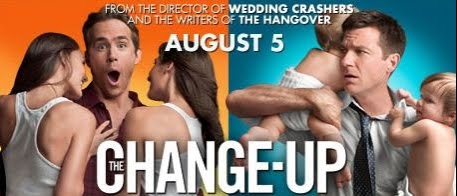
The posters I’ve seen for the Ryan Reynolds/Jason Bateman film “The Change-Up” succeeded only in repulsing me. Based on some professional experience, I presume that is never the intent of a competent advertising campaign for anything. My curiosity aroused, I went to the film’s official site, where I discovered the following image:

An extremely excited, even given the circumstances, Reynolds is holding up two underwear models — or, as this most likely takes place in the film world of male fantasy, probably a barely dressed tax attorney and an art gallery owner. Based on how they are positioned relative to Reynolds, they must weigh no more than 100 pounds combined or perhaps the look on his face is an expression of pain from the resulting hernia that will cut short their evening.

I should also add that there’s been only 4 independently corroborated and factually verified threesomes in the history of western civilization and they all involved Gene Simmons. Yet, most TV shows and movies of the past 20 years make it seem as if they are as common as public figures sending photos of their private parts to random women they met on the Internet.

Reynolds’ delight is set in contrast to Bateman’s despair as he contends joylessly with his two children (they must be his, as basic etiquette demands that you don’t look like you want to hang yourself when holding someone else’s kids). The similarity in attire and behavior of the two babies and the two babes makes the infantilization of Reynolds’ playthings pretty overt.

This image is actually not as offensive as the ones I’d seen on buses and subways, which feature close-ups of the leads. Bateman is still visibly annoyed, as one of his burdens picks his nose. Reynolds, apparently told he was filming a sequel to “American Psycho,” smirks predatorily as his companion — he’s down to one now — plays with his face with her feet. I’m uncertain and uninterested as to the physics behind this.

The other official poster, which I found online, is as Darcy said in “Bridget Jones’s Diary,” “the worst of the three.” Reynolds’s actions actually manage to divert Bateman’s attention from his mewling brats. The tax attorney’s hand is missing, much to Reynolds’s pleasure, and the art gallery owner is a photoshop collage. I don’t think her head, arm, or back belong to the same person.

The posters also make a point of informing me that the film is from the director of “Wedding Crashers” and the writers of “The Hangover.” I didn’t see either of these movies, so this campaign has not even come close to tempting open my wallet. But I am left wondering what the film is actually about, if anything, so off to YouTube I go for the trailer.

OK, 18 seconds in and we have a visible baby poop joke, which literally appears over the words “family man,” as we’re introduced to the suburban hell of Dave (Bateman). Another 10 seconds and we meet “single man” Mitch, who despite living in a hellhole has a gorgeous woman showing up and removing her clothes. By the way, I lived in a crappy New York apartment and my life was more like this:

After a minute and 15 seconds, we get the concept: Single man and family man trade lives while publicly urinating. Sometimes it’s best not to try and explain it.

The trailer is actually less awful than the posters, which you’d expect to turn up in a Susan Faludi lecture. Reynolds and Bateman are personable actors, but the premise is tiresome and consistently one-sided as depicted in media. Men love being single as they physically channel surf through an idealized female population. Women can’t stand it and fear dying alone even if they’re still in their early 20s. The ladies in “Sex and the City” didn’t even enjoy being single and they were the most emulated women of the ’90s.

Although the swinging single/married schlub trope is not new, it has altered a bit over the years. The prototypical single man was more a woman’s fantasy — think Cary Grant or Rock Hudson — than an overgrown adolescent in a dirty apartment. His sexual exploits would have been subtly implied in a poster by unkempt hair, his collar askew, and lipstick prints on his cheeks. The owner of the lips would be more Grace Kelly glamorous than objectified extra from central casting. His married counterpart might envy him — while also acknowledging that he was never Cary Grant in the first place — but the focus of Bateman’s agony is less that he’s had to grow up and become his father. Once upon a time, you could still be Don Draper and be married with kids. No, his horror is in having become his mother, which makes “The Change-Up” less about the stereotypical loss of freedom that comes with marriage but more about the perceived, post-feminist loss of masculinity itself.

 
Leave a comment

Posted by on July 15, 2011 in Pop Life


Tags: , ,