RSS

Recurring Feature (at least until Dec. 26): It’s a Wonderful Lives…

Recurring Feature (at least until Dec. 26): It’s a Wonderful Lives…

When “It Happened One Christmas,” a gender-bending take on “It’s a Wonderful Life,” debuted on ABC in 1977, the 1947 Frank Capra original with was rarely seen on TV. This soon changed in the 1980s when it became almost impossible to turn on your set in December and not stumble upon some portion of the film. As a result, I think it’s likely that those under 30 have never seen the remake.

That’s a shame because if you’re inclined to watch “It’s a Wonderful Life” multiple times, there’s no harm in seeing this version at least once. It stars Marlo Thomas (“That Girl”) as Mary Bailey Hatch and Wayne Rogers (“M*A*S*H”) as George Hatch. Although she has the same name as Donna Reed’s character from “It’s a Wonderful Life,” she’s basically playing the Jimmy Stewart character with Rogers serving as dutiful husband George.

Cloris Leachman plays Clara, Mary’s guardian angel, and Orson Welles (yes, Orson Welles) is the evil Mr. Potter. Welles is particularly fun to watch as one of the great screen villains.

The update remains set in the 1940s — requiring a bit of suspension of belief regarding Mary’s choices in life but whatever, this is a movie with an angel. The clip I’ve included is the part everyone knows — arguably even the few who’ve never seen “It’s a Wonderful Life”: Mary is delighted to discover that she’s returned to the reality she knows instead of the Wal-Mart at every stoplight nightmare she’d just witnessed. Reinforcing the Christ allusion is the fact that she has no reason to believe there’s a happy ending waiting for her. She’s even pleased when the police greet her with a warrant for her arrest. So what if she spends Christmas in the slammer, her mission has been accomplished… I guess. I mean, if she winds up in jail and her business fails, there’s nothing to stop Mr. Potter from moving on with his plans to turn Bedford Falls into a tacky Las Vegas or, simply, Las Vegas.

Fortunately, Mary’s friends and family bail her out — she’s too nice to fail. Wendell Jamieson pointed out in The New York Times that George (and his female doppelganger) would still have been liable for the colossal incompetence that led to the funds going missing in the first place. Shows you what Jamieson knew: He wrote this piece in 2008 around the time of the Emergency Economic Stabilization Act (i.e. “bank bailouts”). If you’ve read Andrew Sorkin’s “Too Big To Fail,” you’d know that there were apparently countless senile Uncle Billys handing avaricious Mr. Potters newspapers filled with money (or more specifically mortgages that were worth about as much as a newspaper). These guys are still in business somehow, which makes the ending of “It’s a Wonderful Life” and “It Happened One Christmas” sadly realistic.

“It Happened One Christmas” is not available on DVD and despite The Hallmark Channel finding time for “Lucky Christmas” on its holiday roster, there are no upcoming airings scheduled this year. You can see it at the Paley Center for Media in New York, which used to be the Museum of Television and Radio, where I practically lived during the late 1990s. It was renamed in 2007 to reflect its inclusion of Internet, mobile video, and podcasting and to also make me feel like a fossil.

 
Leave a comment

Posted by on December 5, 2011 in Pop Life, Social Commentary


Tags: , , , , ,

Occupy Gotham…

Occupy Gotham…

Frank Miller, author of “The Dark Knight Returns” and “Sin City,” last month expressed his views about the Occupy Wall Street Movement. They were no more cogent than what your conservative uncle might have said after his fifth glass of wine at Thanksgiving dinner. Miller, however, is (relatively) famous, so the media ran with it.

‘” ‘Occupy’’ is nothing but a pack of louts, thieves, and rapists, an unruly mob, fed by Woodstock-era nostalgia and putrid false righteousness. These clowns can do nothing but harm America.”

I haven’t read about any stealing and raping occurring at Occupy protests or even raping and pillaging at an “Occupy Treasure Island” demonstration. I also think few people under 40 even remember Woodstock — including the second one. It’s sort of a knee-jerk reaction conservatives over 50 have to anything that reminds them of the summer of love. It’s as if the odor of hippies is imprinted in their senses and results in the occasional patchouli-tinged flashback.

Miller labeled the protestors “iPhone, iPad-wielding spoiled brats” and suggested they “stop getting in the way of working people and find jobs for themselves.” The Wall Street Journal stated that the “vast majority of demonstrators are actually employed, and the proportion of protesters unemployed (15%) is within single digits of the national unemployment rate (9.1%).” Most of the demonstrators are under 30 but 28 percent are over 40.

I suppose it’s the media coverage of the encampments that lead people to think the protestors are unemployed vagabonds. That’s the only major difference I see between Occupy and the Tea Party, and the latter was never described this way.

Of course, if there were that many desperate, unemployed people, it would be a serious issue beyond the economic inconvenience of rising police overtime (at least some of the 99 percent are making money out of this) or the aesthetic unpleasantness of large groups camping out in public places. By the way, the point of a protest is to be inconvenient and unpleasant. If it’s easily ignored, you’ll pay as much attention to it as the flashing light on your car dashboard that indicates something you should deal with but not right now.

Don't you miss these peaceful, constructive rallies by non-hippies that didn't cost the country a dime because we weren't afraid of them?

I had mostly ignored Miller’s comments until Alan Moore, author of “Watchmen” and “V for Vendetta,” responded to them this weekend:

“Frank Miller is someone whose work I’ve barely looked at for the past twenty years… I thought the ‘Sin City’ stuff was unreconstructed misogyny, ‘300’ appeared to be wildly ahistoric, homophobic and just completely misguided. I think that there has probably been a rather unpleasant sensibility apparent in Frank Miller’s work for quite a long time.”

Moore’s statement interested me. It’s easy to assume that the combination of age and wealth caused Miller to go off his rocker. He wouldn’t be the first. However, it is interesting to go back and examine the work he published in the 1980s, specifically “The Dark Knight Returns” and “Batman: Year One.”

The future that Miller depicts in 1986’s “Dark Knight” satirizes both the media and the government’s fecklessness with almost chilling prescience. The TV anchors are vapid and muzzled by the FCC. Superman is a tool of the federal government, and the local police are useless, primarily because Commissioner Gordon has retired and his (female) replacement just doesn’t understand that you need a masked vigilante on the streets to maintain law and order. The Feminine mystique has even infected the penal system — Arkham Asylum is now the Arkham “Home.” Two Face is about to be released —  ostensibly but not really cured. Bruce Wayne, long since retired as Batman and now reduced to an emasculated, drunken shell of himself, enables the rehabilitation, which of course fails (you can’t save these people) and requires the return of Batman and the more masculine approach to justice.

The concept of the masked hero is interesting. Zorro, Batman… these are all men of privilege who hide their identities so they can continue to exist in that world. They have something to lose. Some have made the connection to the Klan, who professed to “maintain” the “rightful” order of things while dressed to terrify their victims and remain anonymous.

Miller’s Batman is obsessed with the nameless thug who killed his parents. He has dedicated his life to fighting a symptom (crime) rather than seeking a cure (poverty). There was a period prior to the release of “Dark Knight” when Bruce Wayne opened the “Wayne Foundation,” a charitable organization that sought to clean up the streets during the day rather than just at night. A connection had been made between extreme poverty, the resulting desperation, and crime. That is not evident in “Dark Knight.” The notable victims of rising crime rates are the affluent like Bruce Wayne’s parents. Their territory — the area they are free to wander unmolested — has been infringed, and that’s enough to drive an otherwise sane rich white man to his cape and cowl.

Batman’s model inspires some mindless thugs to call themselves the “Sons of Batman” and purge the streets through violent means. It’s their own Occupy Gotham. The poor and disenfranchised are now fighting each other rather than bothering people who are important because they own things. Moore references this in his final zinger to Miller:

“I’m sure if it had been a bunch of young, sociopathic vigilantes with Batman make-up on their faces, he’d be more in favor of it. We would definitely have to agree to differ on that one.”
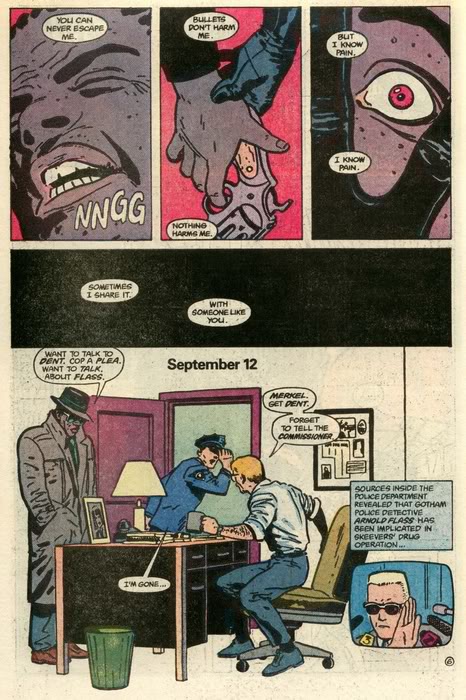
“Batman: Year One,” released in 1987, is a low-key, noirish counterpoint to the more operatic “Dark Knight.” However, many of the themes remain: The cops are either corrupt or useless, and it takes a rich kid to straighten things up. One scene I thought was cool when I was 13 I find repugnant today: Batman breaks into the hotel room of a potential witness against a corrupt cop and convinces him to testify through methods that would please Dick Cheney. This is not really heroic. It just uses a mob technique for the “good” of society, but what was it Nietzsche said about fighting monsters? I recall pre-Miller Batman stories when our hero would have protected the witness from harm rather than just threatening to harm him more than the bad guys would. These were truly the Reagan years with more emphasis on “Dark” and less on “Knight.”

It’s dangerous to believe that “laws” and “rights” are just things criminals use to hide from justice, and that a masked man (or worse, his army of unstable loons) violating them is the only answer. I find it fascinating that the guy who wrote these stories is so irked by a generally peaceful demonstration against society’s excesses. Perhaps he’s afraid of what could happen if the protestors suddenly begin taking orders from someone who views the world as he does.
 
Leave a comment

Posted by on December 5, 2011 in Political Theatre, Pop Life


Tags: , , , , ,

“Loopin’ the Loop”…

“Loopin’ the Loop”…

My post yesterday about the “Chicago” revival’s 15th anniversary inspired me to put on the 1975 original cast recording. I would humbly argue that “Chicago” is Kander and Ebb’s finest achievement: Every song is a knockout. I would less humbly argue that the 1975 original cast recording is the best way to enjoy the musical when at home.

The 1996 revival recording is very good, but whenever I conduct my own Pepsi Challenge, I consistently prefer the 1975 original. This could easily boil down to two words: Gwen Verdon. You just can’t match her. However, Jerry Orbach (“Law & Order”) is brilliant as slick lawyer Billy Flynn — years before he would become everyman cop Lennie Briscoe, and Barney Martin (“Seinfeld”) truly defines “Mr. Cellophane.” I’ve never heard a better version than his. The only exceptions are — perhaps telling for me — Bebe Neuwirth’s versions of “I Can’t Do It Alone” and “When Velma Takes the Stand.” No one can touch Neuwirth’s comedic timing. I also think the orchestra is overall tighter in the original.

Personal tastes aside, it’s ultimately academic because you should really own both recordings. Unfortunately, due to space limitations for vinyl, the 1975 recording lacks “I Know a Girl,” “Entr’acte,” and “Hot Honey Rag.” “Me and My Baby” is also truncated. The 1996 album has them all in full.

If you don’t already own the 1996 recording, I’d recommend picking up the two-disc 10th anniversary edition. You’ll get the revival plus some extras. Most are forgettable (Melanie Griffith singing “Me and My Baby” and a curiously cast Lynda Carter performing “When You’re Good to Mama”), but it’s worth the full price just to hear the Kander and Ebb demos “Ten Percent” and “Loopin’ the Loop.”

“Ten Percent” was cut from “Chicago.” David Hyde-Pierce explains why in this neat clip of him performing the song.

Loopin’ the Loop” was intended to serve as the finale, but “Nowadays” replaced it because reportedly director/choreographer Bob Fosse wanted something “more glamorous.” I’d never second-guess Mr. Fosse, but I think “Loopin’ the Loop” would have solved the problem of “Chicago” not really having a song that’s about Chicago. However, “Loopin’ the Loop” lives on — sans vocals and with a snippet of “All That Jazz” at the start — as the “Overture,” which is a minute and a half of concentrated magic that never fails to perk up my mood when I hear it.

This is a Holy Grail clip I found on YouTube of 1975 “Chicago” rehearsals prior to the removal of “Loopin’ the Loop.” It’s the sort of thing you can’t believe exists.

 
Leave a comment

Posted by on December 4, 2011 in Pop Life


Tags: , , , ,

“The Twelve Pains of Christmas”…

“The Twelve Pains of Christmas”…

In 1988, Seattle radio personality Bob Rivers released his holiday novelty album “Twisted Christmas” — not to be confused with Twisted Sister’s 2006 “A Twisted Christmas.”  My favorite song from the album — though, I think it’s the only one I can remember ever hearing — is “The Twelve Pains of Christmas.” The following year, when the tune resurfaced for its annual holiday rounds, I recorded it off the air, most likely from John Garabedian’s “Open House Party,” which was my girl-less Saturday night entertainment for most of high school.

“The Twelve Pains of Christmas” sends up the holiday standard “The Twelve Days of Christmas,” which I’ve never enjoyed so the mocking nature of Rivers’ song especially appealed to me. My 20-year-old mixtape containing the last 11 verses of the song long since died (I wasn’t quick enough to get the first verse — a conundrum lost on most members of the iPod generation), but I was pleased to discover that the entire album is available for download on iTunes.

There was no official video made of the song, but there are a few fan-made versions on YouTube.

This one features one guy as all the characters. I include it mostly so you can hear Rivers’ original recording.

But this one’s really nifty: The Madrigal Singers of Boston College perform the song live in period costume:

Rivers followed up “Twisted Christmas” with 1993’s “I Am Santa Claus.” Although not as darkly accurate a depiction of the holiday season as “The Twelve Pains of Christmas,” “Walkin’ ‘Round In Women’s Underwear” — a parody of “Winter Wonderland” — is an amusing ditty if you’re into the whole Weird Al/Dr. Demento thing. If not, I’ve probably wasted your time.

 
1 Comment

Posted by on December 3, 2011 in Pop Life


Tags: , , ,

15 years of “Razzle Dazzle”…

I neglected to mention on Nov. 14 that the “Chicago” revival had marked its 15th year on Broadway. Put in perspective: It’s the longest-running revival on Broadway and the fourth longest-running Broadway musical with 6240 performances, edging out its former rival “A Chorus Line.” It seems to show no signs of slowing down, which is cause for concern for current number three “Les Misérables.”

During my freelance writing days in New York in the mid-90s, I made extra money (sometimes not even extra — just money) working front of house selling souvenirs (programs, t-shirts, and mugs) at the Shubert Theater, then home of “Chicago.” It’s not hard work — you’re on duty for half an hour prior to the show, during intermission, and then 15 minutes after the show ends. Otherwise, you can spend your downtime hanging out with the bartenders in the lounge (only some of whom weren’t actors but all had great stories to tell), preparing for an audition (like the aforementioned actors), or browsing through the Virgin Megastore in Times Square (now since gone, alas). If you were a particularly obsessed theater fan as I was, you’d watch the show — not just once, as everyone did on their first night, but pretty much every night. It was like the gay version of “The Rocky Horror Picture Show”… wait, no that doesn’t make sense. It was like “The Rocky Horror Picture Show” but you didn’t shout or throw things at the stage.

It’s impossible to overestimate the impact of the show for me back then. There were days where the major impetus to get up in the morning was the knowledge that I was going to hear the opening strains of the overture that night. It was theatrical Prozac.

I started working at the Shubert just after Marilu Henner (“Taxi”) had replaced Anne Reinking, the show’s choreographer, as Roxie Hart. There was a lot of talk about how clearly superior Reinking had been in the role, which might have been the case (I never had the chance to see her — even when she later returned for a brief engagement, I was out of town), but I thought Henner did an admirable job. It’s not a true comparison, but when I listen to the revival’s cast recording, I think that Henner had a bit more emotion and range during her big number, “Roxie,” than Reinking. Henner was also head and shoulders above some of the later unfortunate bits of stunt Roxie casting, including Ashlee Simpson-Wentz and… actually, it’s hard to get much worse than that.

Bebe Neuwirth at the 15th anniversary performance of "Chicago"

Bebe Neuwirth was phenomenal and with all respect to the wonderful Chita Rivera, who created the part, it’s Neuwirth who I will forever associate with Velma Kelly. Her name recognition as Lilith Sternin-Crane from “Cheers” and “Frasier” probably helped bring people through the door, but they were blown out of their seats by her performance. I’m nowhere near talented enough to adequately describe how she set fire to the Shubert’s stage on a nightly basis, so thank Marilyn for YouTube.

I would swap nights between “Chicago” and “Grease,” which was at the Eugene O’Neill Theatre. I referred to my time at “Grease” as “Grease Hell” — everyone there was in hell, the cast, the crew, the audience. It was not enjoyable. Worse, you couldn’t lock up your souvenir stand at “Grease,” so you had to sit through the entire show – a rather cruel irony, as I was free to come and go at will at “Chicago.” I don’t recommend seeing this production of “Grease” once let alone almost a dozen times. Even mediocre songs performed poorly can stick in your head. One of the bartenders at the Eugene O’Neill would occasionally sing her unique version of “Born to Hand Jive” but would replace “jive” with “job.” Not to be ungallant but I believed her. I eventually made the bold move of asking to work only “Chicago.” My very English boss at the time shrugged and said, “Sure.” My first hard-ball business negotiation.

The best part of seeing the show eight times a week was that I could focus on other members of the cast. Some of my favorites were Bruce Anthony Davis, Jim Borstelmann — one of the great gypsies of Broadway, Mary Ann Lamb, Caitlin Carter, and Leigh Zimmerman, who later played Velma in London’s West End. You could spend a night just watching one of them and be thoroughly entertained.

When Zimmerman left “Chicago,” she gave farewell presents to all her coworkers — including those of us working front of house. I thought that was classy at the time and have come to appreciate the gesture even more after later working at companies where the “rank-and-file” employees (yes, they used that term) were viewed as mostly disposable resources rather than as extensions of the same united effort.

I don’t recall if it was either my last night at the show or Neuwirth’s, but my boss — now longer English but another nice guy — gave me a “Chicago” program that Neuwirth had inscribed to me over her photo on the inside page. I’ve never been one for autographs but this is definitely one of my most prized possessions — now preserved behind glass, as my memories of this show in its early days are forever preserved in my mind.


1 Comment

Posted by on December 3, 2011 in Pop Life


Tags: , , , , , ,

Recurring Feature (at least until Dec. 26): It’s a Wonderful Lives…

“It’s a Wonderful Life” is my least favorite film that my favorite actor (Jimmy Stewart) made — that’s not a dig, as it’s sort of like referring to your least favorite sunset in Paris. However, I’ve probably seen it the most often due to the period in the 1980s when it was shown constantly (this phenomenon was satirized in a 1987 episode of “Cheers”).

Either as a side-effect of getting older or simply the times in which we live, I confess that the film becomes more bittersweet with each year’s inevitable viewing. Are there any George Baileys left in the modern world? Were they all ground under the iron heel of the Mr. Potters who run our corporations, our banks, and, well, our country? Yet, every year, Americans curl up with a glass of eggnog and root for George while later voting for Mr. Potter, who is quite clear in his intent to pave over Bedford Falls and erect a consumerist Pottersville-nightmare.

Oh well, Christmas is, after all, all about cognitive dissonance, so let’s just embrace it until our bleary-eyed, New Year’s hangover greets us in 2012.

If “A Christmas Carol” offers the promise of redemption, the appeal of “It’s a Wonderful Life” is the notion that your life actually matters and has a demonstrably positive effect on other people. It warms even the coldly cynical part of me that believes the universe is just too big for one person’s absence or involvement to make much of a difference. And before anyone counters with Hitler, I would point out that there’s always someone next in line.

In 1996, I spent Christmas Eve in a bar just to recreate this moment.

Also, like “A Christmas Carol,” “It’s a Wonderful Life” has inspired countless explorations of its themes in TV and film. I’ll be generous here and call them “homages.” The effective “It’s a Wonderful Life” formula requires a decent man pushed to the brink and a satanic figure who would run riot in the world if that good man gives up in the face of his endless struggle with him. The film is an obvious Christ allegory but with a happy ending — God intervenes and prevents George’s suicide rather than insisting it’s part of a larger plan, and the people of Bedford Falls do not abandon George in his most vulnerable moment. Yeah, maybe the Christ story is more realistic.

I thought it might be fun — if for no one but myself — to revisit a few of these “It’s a Wonderful Life” remakes in their various forms (as I plan to do with “A Christmas Carol”). The first one is from a 2008 episode of the daytime soap opera “The Young and the Restless,” which always featured a Christmas-themed episode I found myself watching during my single days. In a way, it combines both “A Christmas Carol” and “It’s a Wonderful LIfe” — Michael Baldwin, unlike George Bailey, is no saint. Years ago, he was a pretty vile character who committed acts that would make Herman Cain blush. He’s since redeemed himself and, as the following clips reveal, makes the world around him a better one.

I personally doubt this will happen with Cain, but who knows? He’ll probably need the help of three spirits but those guys do good work.

 
Leave a comment

Posted by on December 2, 2011 in Pop Life, Social Commentary


Tags: , , ,

How the Gingrich insults poor people…

Newt Gingrich has a curious hobby. No, not his semiannual weddings but his habit of insulting poor people.

Recently, Gingrich suggested “that American school systems should fire their unionized janitors and let underprivileged children do the work instead, according to a report in Politico.” It’s worth noting that he made these comments to the countless underprivileged kids at Harvard University.

This was rejected as more of Gingrich’s typical, “are there no prisons?” nonsense — similar to his statements about orphanages back in the early ’90s. Dave Jamieson at The Huffington Post dismantled Gingrich’s argument:

Despite its relatively modest pay, a janitor’s job isn’t as easy as Gingrich seems to think it is. According to the Labor Department, a janitor needs to be able to carry out a long list of duties and repairs during a typical day: Mop and polish floors, handle dangerous chemicals, even perform basic electrical and plumbing repairs. At schools, they also need to interact well with children and, at times, clean up their vomit.

A janitor’s job is also more dangerous than most American occupations — and hardly fit for children, according to the Labor Department’s description of the work. Janitors, it notes, “may suffer cuts, bruises, and burns from machines, handtools, and chemicals. They spend most of their time on their feet, sometimes lifting or pushing heavy furniture or equipment. Many tasks, such as dusting or sweeping, require constant bending, stooping, and stretching.”

Gingrich did not skulk away quietly in the light of reason. He now claims his views were “spun out of control” by “the left” (yeah, those guys again).

“Really poor children in really poor neighborhoods have no habits of working and have nobody around them who works,” the former House speaker told an audience at the headquarters for Nationwide Insurance.

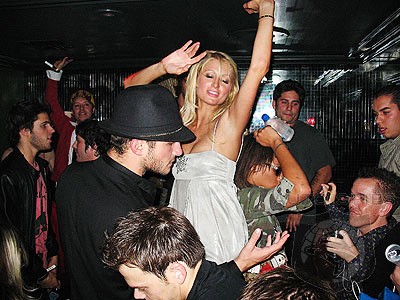
Paris Hilton demonstrates the work ethic and value of a dollar her family fortune instilled in her.

This is demonstrably false and insulting. Poor children see their parents working sometimes multiple jobs in order to survive. He seems to have the poor confused with the idle rich, such as (Pick Your) Kardashian and ex-con Paris Hilton.

He then seemed to imply that a young, poor individual’s only likely source of possible income would be from breaking the law.

“They have no habit of ‘I do this and you give me cash’–unless it’s illegal.”

Again, I think he’s confused the poor with his buddies at Freddie Mac. True, no one has been arrested yet for bringing down the U.S. economy and quite a few people in poor neighborhoods are arrested because they live in poor neighborhoods.

Gingrich added that most successful businesspeople he knows started work “early” and made some kind of money when they were kids, whether it was by babysitting or mowing lawns.

He’s describing in a general sense what we call “chores” — a valuable, character-building concept but not technically “work.” I mowed the lawn myself (the backyard until my father trusted me near the front yard when I was in high school) but that was for comic book money. I never had to work to put food on the table. And I never had politicians suggesting that my father should lose his job and — if that wasn’t enough of a punch in the gut — his teenage son should replace him for a fraction of the cost.

“What if you paid them part time in the afternoon to sit in the clerical office and greet people as they came in? What if you paid them to work as the assistant librarian? And I’d pay them as early as is reasonable and practical,” he said Thursday.

What Gingrich isn’t addressing is that working-class jobs — be they clerical or janitorial — used to be something for which an adult could earn a living wage. Gingrich and his ilk have pretty much eliminated that. And, yes, technology has also done its part. However, if you wish to invest in children and their future, the key is education. After-school programs such as the Drama Club, yearbook, or orchestra instill responsibility, teamwork, and improve self-esteem. Let’s actually focus on putting these poor kids’ parents back to work. This doesn’t mean that after-school jobs for kids is a bad idea. I learned a lot working in a supermarket in high school. I was able to even open my first checking account. However, Gingrich does a disservice to everyone by insisting these “moral” lessons are exclusive to the poor. A rich kid can benefit from sweeping the floors of his school, as well.

Gingrich may be many things not printable in a family publication but he’s not stupid. The contempt he’s shown for the poor with these comments and also his comments about the Occupy movement implies that he believes a majority of U.S. voters think this way. We need to prove him decisively wrong.

 
Leave a comment

Posted by on December 1, 2011 in Political Theatre


Tags: , , ,

It’s still a bum deal, Ms. Richards…

It’s still a bum deal, Ms. Richards…

The great Holland Taylor is currently performing in a one-woman show about former Texas governor Ann Richards (“ANN: An Affectionate Portrait of Ann Richards“) at the Charline McCombs Empire Theater in San Antonio, Texas. This is essentially the chocolate and peanut butter of theatrical experiences as it combines two of my favorite people.

Ann Richards electrified everyone watching — including the 14-year-old me — when she delivered the keynote address as the 1988 Democratic National Convention. Every line was Julia Sugarbaker gold but the most remembered is her lament for “Poor George (H.W. Bush)… He can’t help it. He was born with a silver foot in his mouth.” One less recalled line but one that still rings true is, “And you don’t have to be from Waco to know that when the Pentagon makes crooks rich and doesn’t make America strong, that it’s a bum deal.”

Of course, beneath the sharp wit is the sadness of what came to pass: The Reagan Era that Richards says was soon to end obviously didn’t. I always thought it was because we sent a Dukakis to do a job best suited for a Richards.

Ms. Richards was governor of Texas from 1991 to 1995. She had struggled with alcoholism in her life but that battle helped inform a compassionate means of dealing with substance abuse and crime:

… the state of Texas, when I was governor, we built an awful lot of prisons. And to be frank with you, I made a deal, and the deal was that I would help pass the legislation and be for building a lot more prisons in Texas if I could get rehab programs for people who were alcoholics and drug abusers because I knew that over 80 percent of the crime committed in Texas was committed by people under the influence of alcohol or drugs.

And unless you treat that alcoholism and you treat that drug addiction, when they go right back out on the street, you got a drunk or you’ve got an addict that is going to commit a crime again.

George W. Bush defeated Ms. Richards in 1994. Karl Rove, the brains behind this victory, cynically stated that her loss was attributable in part to her opposition to a concealed weapon bill, which Bush later signed into law while also executing more prisoners than any other governor in history (he obviously did not see the cognitive dissonance here), and her warning to a Girl Scouts conference to beware of “Prince Charming on a motorcycle with a beer gut and a wandering eye.” That was actually pretty sound advice — not just for Girl Scouts but for the whole country. Rove is less upfront about the dirty tricks that were linked to him during the campaign.

In 1994, when Bush ran against Democratic Gov. Ann Richards in Texas, a whisper campaign began in East Texas that Richards had appointed gays and lesbians to state positions, which was true. The issue got little notice until Bush’s East Texas campaign chairman accused the governor of naming “avowed and activist homosexuals” to high offices.

I am impressed that 20 years ago Ms. Richards hired qualified people regardless of their sexual orientation (“avowed and activist” is usually translated to mean “not frightened and in a closet”). I also appreciated her inclusiveness — speaking Spanish during her keynote address in recognition of her state’s background.

Here is a clip of Holland Taylor as Ms. Richards in the play she painstakingly researched and wrote herself. If it eventually reaches Broadway, it will prove a worthy rationale for my brief return to New York.

And, because I love watching it, here’s Ms. Taylor accepting a well-earned Emmy for her work in “The Practice”:

“Overnight,” indeed.

 
Leave a comment

Posted by on December 1, 2011 in Political Theatre, Pop Life


Tags: , , ,

How do you spell (and define) “bimbo”?…

Jon Huntsman is officially off my Christmas Card list.

Commenting on Herman Cain’s calvacade of scandals, the presidential candidate (yeah, really, he’s still in the race) told the Boston Herald that “We’ve got real issues to talk about, not the latest bimbo eruption.”

What the hell is that?

Here’s a real issue, for you, Mr. Huntsman: Why don’t we discuss the casual disregard for women you display by throwing around the word “bimbo” like you’re someone’s 90-year-old grandmother using the word “colored.” “Oh, what? They don’t like to be called that anymore? It’s so hard to keep up. I liked that Nat King Cole, though. He was a good one.”

Checking the dictionary, “bimbo” is defined as “a generalized term of disapproval especially for an attractive but vacuous person” or, more offensively, a “tramp.”

So, who are these bimbos erupting from Cain’s now practically dormant volcano?

Sorry, Jon, no bimbos there, either.

The Huffington Post kindly provided a slideshow of Cain’s accusers. First up is Karen Kraushaar, a Treasury Department spokeswoman, who “was an employee at the National Restaurant Association during the time Cain was head of the group.” OK, nothing particularly bimboic about that. The second woman remains anonymous —  The Huffington Post curiously chose to depict her using the image of what appears to be a thinly disguised Portia de Rossi — but we do know she that she also worked at the National Restaurant Association and is currently employed at a New Jersey lobbying firm. No bimbo readings there.

We know little about the third accuser, other than her having worked at the National Restaurant Association and charging Cain “with making sexually suggestive remarks and gestures, even inviting her to his corporate apartment for a private visit. She described his behavior as aggressive and inappropriate, similar to the claims made by the previous accusers.” I tend to err on “innocent until proven bimbo” so let’s move on to the fourth woman, Sharon Bialek, a professional woman and mother, who was the first to make a public statement and whose treatment by Cain’s camp and the conservative media arguably initiated the trickle-down creepiness that led Ginger White to come forward this week.

It’s possible Huntsman was confused by the smear job the Cain people put out on these women, which attempted to paint them as modern-day Evelyn Nesbits. Maybe he was just referring to Ginger White, the only one of the party of five to state that a consensual sexual relationship took place, rather than sexual harassment and sexual assault. It might be a little judgmental to call an Atlanta businesswoman a “bimbo” just because she had an extramarital affair, but I’m sure that’s the same pejorative used for Congressmen who troll for women on the Internet or who dress up in tiger suits when not fooling around with the teenage daughter of campaign donors. What? No? Well, that’s peculiar.

Huntsman is not even capable of original insults. “Bimbo eruption” dates back to the 1992 presidential campaign when political consultant Betsey Wright used it to describe the inconvenient women with whom Bill Clinton most likely had sex. I’m sure Ms. Wright is awfully proud of the mark she’s made in history and for women’s rights.

Sorry, Jon, I tried to find these “bimbos” for you but no luck. If it’s any consolation, I do know where to find a big jerk.


2 Comments

Posted by on November 30, 2011 in Political Theatre, Social Commentary


Tags: , , , ,

The “Anyone But Romney” Sweepstakes…

The “Anyone But Romney” Sweepstakes…

If Herman Cain’s presidential campaign collapses under the weight of multiple sex scandals — similar to the effect of piling topping after topping on a thin crust pizza, it appears that Newt Gingrich is the likely beneficiary in the “Anyone But Romney” sweepstakes.

It must be hard for Romney. He’s clearly the guy but no one is all that excited about it. Democrats are afraid he might win, and even Republicans are afraid he might win. There’s a collective resignation about his inevitability. He’s the Greg Kinnear/Bill Pullman character in the romantic comedy, and the GOP is Meg Ryan, desperately waiting for Tom Hanks to show up and sweep her off her feet.

Alas,politics is just as disappointing as romance in the real world — your Tom Hanks turns out to be Rick Perry, who has grand plans of turning Congress into a part-time job (which, logically, would ensure that only the wealthy could afford to do it) but that plan is stymied by his not seeming to understand what the legal voting age is.

But even Tom Hanks made “Joe Versus the Volcano.” Let’s toss Perry into one and move onto the next possibility — Herman Cain. Sure, he’s less Hanks and more Denzel Washington but he’s still not Romney.

Mr. Cain, the former chief executive of Godfather’s Pizza, does not follow any of the traditional rules of presidential politics. He has no political experience. His campaign has raised almost no money and as a result has virtually no staff or infrastructure. And Mr. Cain appears to make few of the tactical calculations that drive most presidential campaigns.

OK, he doesn’t look that good on paper, but you know who does look good on paper? Romney, and we don’t like him. This is simple deductive reasoning. So, Cain’s an unconventional candidate — what could go wrong?

Hmmm, so on reflection, Cain might be less Denzel Washington and more George Jefferson.

This brings us to Newt Gingrich. I don’t blame you if you’re confused. The non-Romney front runners in the GOP race are harder to keep track of than the current best friend of a teenage girl.

Gingrich might seem an implausible choice — no “yesterday’s news” candidate has successfully claimed the White House since Richard Nixon in1968. Although his opponents in the primary have positioned themselves as outsiders to the Washington establishment, Gingrich is a former Speaker of the House. His primary business experience, which is Cain and Romney’s selling point, is receiving $30,000 per hour from Freddie Mac for advice (that sounds like a lot but Freddie Mac paid Ann Landers $50,000 an hour for advice regarding the least offensive way of turning down your mother-in-law’s yam bread). Gingrich is also not a particularly fresh candidate: If elected, he’ll turn 70 during his first year in office, which means he’ll only have time to remarry twice at most before he retires.

However, GOP primary voters might be weary of the “Snow White” remake the race has turned into with Dopey, Crazy, Horny, and Doc. Gingrich has no surprises. He’s already had his sex scandal, which is important to get out of the way early — like chicken pox. We also know how the Democrats would receive a Gingrich presidency, based on how they lamented his departure in 1998:

“We are mourning the loss of having Newt to kick around anymore,” said one White House adviser who did not want to be named. “Newt Gingrich literally was the best thing the Democratic Party has had going for it since 1994. . . . If anything, there’s total depression on my side of the fence.”

Yes, the GOP is settling. It’s a great ploy — one Kinnear or Pullman should have tried in those movies. Safe Guy No. 2 comes in and grabs Ryan away from Safe Guy No. 1 before dreamboat shows up. Could Gingrich, who left D.C. in disgrace more than a decade ago — banished to his high-paying private sector Elba, return to the White House in triumph? Of course not. What, are you high? It’s totally going to be Romney, as Nate Silver, who has a brain in his head, correctly points out:

This year, however, a candidate like Mitt Romney would have more time to regroup after an early setback. I’m not just picking Mr. Romney’s name out of a hat. It seems that the candidate who could benefit the most is one who had stronger “fundamentals,” like fund-raising, campaign infrastructure and institutional support, which could potentially outlast transient swings in polling. That describes Mr. Romney better than it does someone like Mr. Gingrich, who does not perform well in these areas.

So, the guy everyone suspects is a secret Democrat (arguably a step-up from secret Muslim socialist) wins the nomination and perhaps selects a Vice Presidential candidate who appeals to the base. If he repeats the McCain Mishap of someone like Sarah Palin, he’s toast. If he selects a charismatic empty suit like John Kerry did with John Edwards, he’s burnt toast. He could look to Ronald Reagan, who chose George H. W. Bush as his running mate in 1980 partly because of Bush’s international experience and ability to appeal to the political center. That center doesn’t really exist anymore, so Romney would need to flip the scenario and select someone with D.C. experience and who appeals to the party’s base, which brings us back to Gingrich.

I guess I’ll go dust off my mid-90s Gingrich material. Some of that stuff was gold.


Leave a comment

Posted by on November 30, 2011 in Political Theatre


Tags: , , ,